
10 November 2026
Running Economy, the holy grail of getting faster?
Nick discusses how improving your running economy could make you faster, without the need for increasing your cardiovascular fitness.

There are probably only three physiologically trainable and controllable things that affect how fast you can run for a set distance. For arguments sake, let’s take mindset, fuelling, weather, shoes and all of the either uncontrollable or psychological limiters out of the equation.
So what are we left with?
- VO2 max
- Lactate Threshold
- Running Economy.
Many people, me included, spend years trying to build 1 and 2 through specifically paced sessions over various times or distances. Training using intervals, tempo runs, threshold runs, Fartlek etc etc.
VO2 max and lactate threshold
VO2 max is defined as the maximum amount of oxygen you can take up and use (measured in ml/kg/min). Lactate Threshold is a bit more nuanced, but essentially is when lactate (lactic acid) starts to accumulate more quickly than it can be recycled and used, which is strongly correlated (although causation is debatable) to a rapid decrease in performance. And whilst improving or maintaining these things is a vital part of any running plan, it’s not the ‘be all and end all’.
Why a high VO2 max and lactate threshold aren’t the only thing we need.
If these metrics were the only thing that mattered, then any elite trained athlete in a cardiovascular dominant sport would also be an elite runner. For example, Tadej Pogacar, possibly the greatest cyclist we have ever seen, has a monster VO2 max and lactate threshold - on a bike. His VO2 max and threshold power would eclipse mine by several orders of magnitude. However, I’d still fancy my chances if we were to toe the line together at a marathon. Some people might think that’s obvious, Tadej is a cyclist…and that’s the point. His bone density, neuromuscular and fascial systems aren’t adapted to running the way that of even a moderately trained runner’s would be. His running economy would be his limiting factor, not his VO2 max or lactate threshold.
Let’s look at this another way with an analogy from a different sport. Formula 1. No coincidence….the only things I watch religiously on TV are cycling and F1 (don’t judge)… Formula 1 cars are the pinnacle of four wheeled motorsport, the most technically advanced and fastest around almost any standard race circuit. However, they’re not the most POWERFUL cars on the planet. A highly tuned road car, available to (admittedly rich) members of the public will often have more horsepower. But it’s not just the size of the engine or the peak power that makes a car fast, it’s all of the other factors - chassis, gearbox, suspension, downforce etc etc. So bringing it back to running, the size of your engine is important, but you can probably get as much additional performance by working on your strength, conditioning and stride mechanics. In the same way there are hundreds of little parts of a race car that need to work together efficiently and harmoniously to allow its engine to be used to its full potential, there are as many parts of your body that need to work in synchrony to allow your heart and lungs to give you the performance you want.
How to improve running economy

Because there are so many components to translating your cardiovascular fitness into running speed, it is impossible to give a ‘one size fits all’ set of guidelines to this. However, as a 43 year old masters runner, I spend a lot of time thinking about ways to improve my economy. It’s probably the only thing left open to me in terms of significant improvements. My maximal heart rate has been consistently declining by 1 beat per minute since my mid 20s. This will be pushing my lactate threshold heart rate on a similar trajectory, although granted my actual pace at lactate threshold will be variable depending on other factors. It’s very well documented that VO2 max declines with age too. So running economy has to be my main performance lever whilst still doing everything I can to maintain my cardiovascular fitness with the usual training sessions.
Gait analysis.
I think this is crucial. So many people have no idea ‘how they run’ or even ‘how TO run’. If you’ve never been filmed whilst running, then maybe get a friend to take some videos or even better, look out for someone who can perform a run analysis on you (this is one of the services I offer at www.rnnng.co.uk). I believe it needs to be outside in the real world, once you’re well warmed up. Jumping on a treadmill for a minute or two in a running shop is unlikely to yield anywhere near the same amount of information. Are you over-striding, heal striking, hunching, leaning, looking down, swinging your arms wildly? All of these will reduce your ability to run efficiently. An experienced coach will give you some pointers as to what you can do to improve your running action, get more speed and probably reduce injuries, without having to work any harder on your cardiovascular fitness.
Lift weights
If you look at most elite runners, they will be doing a significant amount of work in the gym, lifting relatively heavy weights. This causes specific adaptations in the muscles to allow you to generate more power with every foot strike. The harder you can hit the ground without your leg buckling, and the quicker you can push off the ground again, the further you’ll go with each stride. Fast runners aren’t tippy toeing around like they’re on ice, they’re applying Newton’s third law. They hit the ground hard and the ground hits them back equally hard! The stronger you are the more force you can apply. Exercises like back squats, split RDLs, calf raises and Bulgarians etc will all be beneficial. 3x 8 reps with as heavy a load as you can control is about right for most of us.
Plyometrics
Plyometrics train your muscles and tendons to store and release elastic energy more efficiently with each foot strike, decreasing the amount of energy cost at a given pace. So rather than using your muscles, you’re building your body’s ability to use its natural elasticity from its integration of fascia and tendons. Plyo drills like pogo jumps, skipping and box jumps teach your central nervous system to fire fast-twitch muscle fibres rapidly, helping you spend less time on the ground and spring upwards and forwards with more speed. Your ground contact time will be reduced, so your foot is spending less time having the energy sucked out of it when it hits the tarmac.
Core stability.
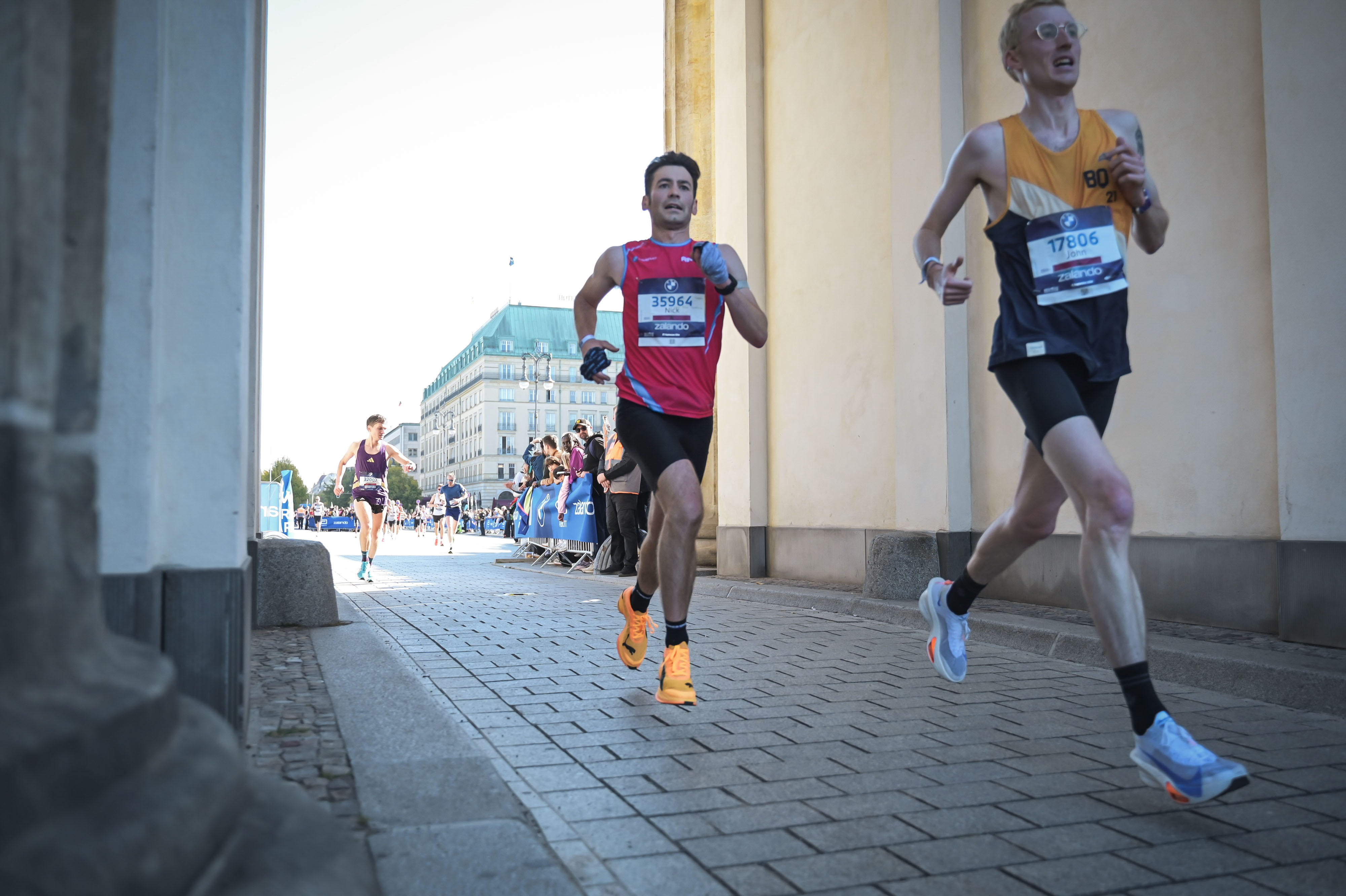
It’s no good having super strong and springy legs if the rest of your body is flopping around like a stranded salmon. Being able to hold your upper body and head in the correct position, leading with the chest and not bending at the hips, will allow your body to use its natural elasticity in full. The longer a race is, the more of a challenge this becomes. How many of us look the same in our marathon pictures at 5k and 35k? As we lose our abilities to hold our body position, our form suffers and running economy dips. So as well as fatigue, dehydration and glycogen depletion, we’re also battling a loss of economy from a biomechanical breakdown. Simple core stability exercises like a variety of planks, side planks, dead bugs, bicycle crunches etc will help you build your core strength.
Running drills.
Approach with caution. If you’re not used to these then they are risky in terms of injury. You definitely need to be well warmed up and not be carrying fatigue from a gym session or hard run.
Strides
These are my favourite drill. 100 metres or 15seconds of fast running, repeated anywhere from 4 to 20 times depending on how well trained you are, with plenty of recovery in between each rep. These should be done somewhere around 1 mile to 5k pace. The focus is on quality, high intensity fast running with excellent form without stressing your cardio system.
Hill sprints
These are another important addition to an experienced athlete’s plan. 4-8 repetitions of a maximal 8-12 second sprint up a steep ramp, again, with plenty of recovery in between each rep. These will build muscular power and fast twitch fibres without the risky high impact and excessive stride length you would get by doing these on the flat. Again, approach with caution if you’re not used to these!
Vary your training paces.
Your body looks to be the most efficient it can for running at a set pace. So if you only ever train at one pace, your body will become better at it over time, but you’ll also find it very difficult to make any break throughs when you want to get faster on race day. By running your easy runs much slower than race pace, you are keeping your body fresher for the hard sessions. Then your strides, intervals and even some threshold work can be run faster than race pace. Over time your body will adapt to become more efficient at running faster and you’re likely to see this translate to improved race times.
In summary, working on your running economy could unlock more speed for less effort, and who doesn’t want that!?!
Keep Showing Up
Nick
RNNNG
← All articles