
8 September 2026
How to run a fast 10k race
The race day preparation and tactics I used to run a sub 35 minute 10km race at Laganside in Belfast
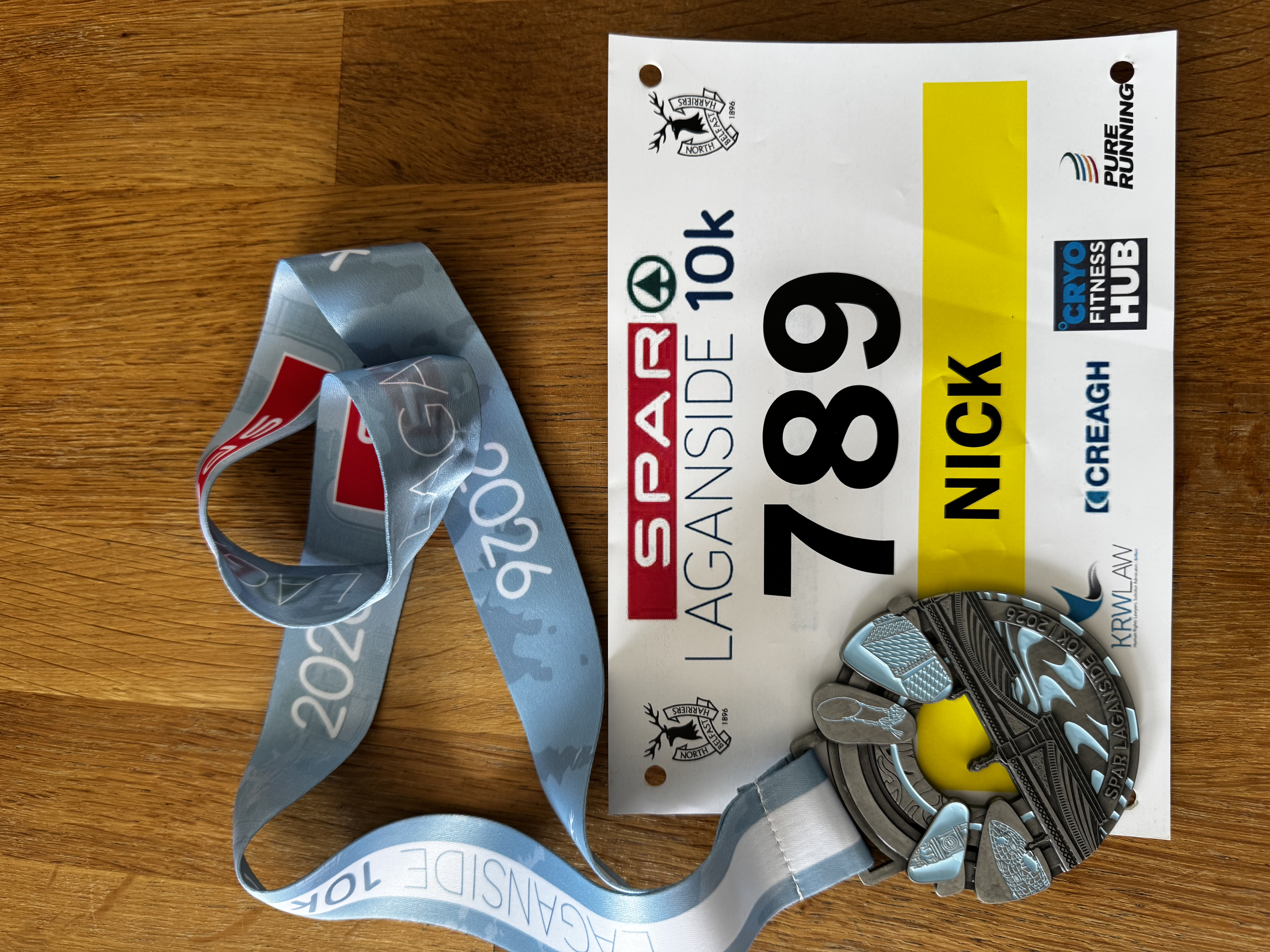
How to race a 10k
At the weekend, I raced the Laganside 10k in Belfast. A well-organised event hosted by North Belfast Harriers, it starts and finishes in Ormeau Park, Belfast, and is essentially two 5km laps. It’s largely flat with closed roads and only a few turns and minor rises to slow you down. However, due to the exposed nature of the course, running along the River Lagan for large parts, the wind often plays a big part in how the race unfolds.
Who races a 10k event?
The 10k is an incredibly popular distance for a few reasons. It’s enough of a challenge to attract novice runners stepping up from coach to 5k or Parkrun, but short enough so that experienced athletes can race hard but recover quickly and be ready to train or race again within a relatively short time frame. The other group of athletes, and I can include myself in this, is those looking to race a half marathon or marathon in a few weeks and need a fitness test or want to do a threshold run with company, rather than grind out a hard 30-40 minute solo session.
I am now less than three weeks away from Berlin, so this race provided me with a true test of where my fitness is as I’m still working through my Achilles tendon issues.
Here’s my take on how to run a fast 10k
It starts at home. I tend to eat a small breakfast at least two hours before the race start, but preferably three-four hours. Laganside began at 12:00, so I ate at 8:30 am. Something bland and not too much fibre/fat/protein. Rapidly digestible and carb-heavy. Toast/banana/honey is my go-to. A black coffee to give a hit of caffeine.
Check the weather - do you need an extra layer or rain jacket for the warm-up? Or if it’s hot, an extra bottle of water to carry with you on the day? Laganside was looking warm, so I decided to pack a mini bottle of water to carry with me during the race; this turned out to be a great decision.
Leave in plenty of time. I’m one of those super early people to races. I hate being stressed about traffic on the way or parking. Get yourself to there and then chill out. Go to the portaloos/toilets early. Nothing worse than worrying about the massive queue when you need the toilet (and I ALWAYS need to go) just before the race starts! Bring your own toilet paper just in case.
I will eat a small snack, cereal bar or similar an hour before the race starts to keep the glycogen topped up. I always have a bottle of water to sip on too. Stress will dry your mouth out and you don’t want any perception of being dehydrated.
Warming up for a 10k race.
This depends on your experience. If you’re a novice looking to complete the distance for the first time, then the walk to the start and a 5-min light jog is more than enough. As a faster runner, I need a lot more preparation to get my body activated. For Laganside, I did a 5k easy run at a recovery-type effort, around 5:00/km, finishing about 30 mins before the race start. I used a pair of Puma Deviate Pure, just a nice comfortable shoe. Then back for a final portaloo visit before switching into my race shoes, which were a brand new pair of Puma Deviate Elite 4. I wanted to test these as a possible Berlin marathon shoe. I’d worn a test pair a friend had lent me (cheers Shoe-dog Dom) for one mile, and knew they were a good shoe. They haven’t got the pop of my favourite R3s, but the 8mm drop seemed to suit my ailing Achilles tendon a lot more.
To complete the warm-up, I ran about 8 x 50-75 metre strides 5-10 mins before the start, leaving it as late as possible because you want your body in the zone and not to cool down again. This is obviously a lot easier in a local race without thousands of competitors. If you have to get into a pen early at a big city event, then just do what you can to keep moving - jog on the spot, standing sprints, whatever it takes. My strides were fast-paced efforts to get the heart rate up, but then a walk/jog back to where I started. These get the body prepared for the instant shock you’re about to give it when the gun goes.
Don’t try anything new on race day
Unless you’re prepared for it to go wrong! So yes, to clarify, I was using a brand-new, unworn, untested shoe. If the 10k race you’re targeting is one you’ve been training for for months, don’t do this…you should have practised extensively in your race shoes. But my A-goal race is Berlin. So this was my practice session for that, plus the geometry is largely similar to the Deviate Pure which I have done a lot of miles in.
10k fuelling and fluid
I took a Maurten 100 immediately before the start. 25g of carbs is plenty to get me through a 35-minute effort. If you’re looking at times of 45-60 mins, then I’d suggest another gel at the 5k mark, or carry an energy drink to sip throughout.
Laganside was warm. I’d already decided to carry a little 250ml water bottle with me as it would save me having to grab any water on course, even if it was just to tip on my head. This tactic alone gained me two places. I was in a group of 3-4 coming down the embankment for the first time, having shared the section into the headwind, rotating the lead in a Tour de France-esque through and off formation with a couple of guys and catching those in front who were isolated. As the two athletes with me veered/slowed to grab cups, I didn’t break stride and just carried on with my water in hand. I ended up a few strides ahead and never saw them again. Marginal gains….
Drafting and working with others
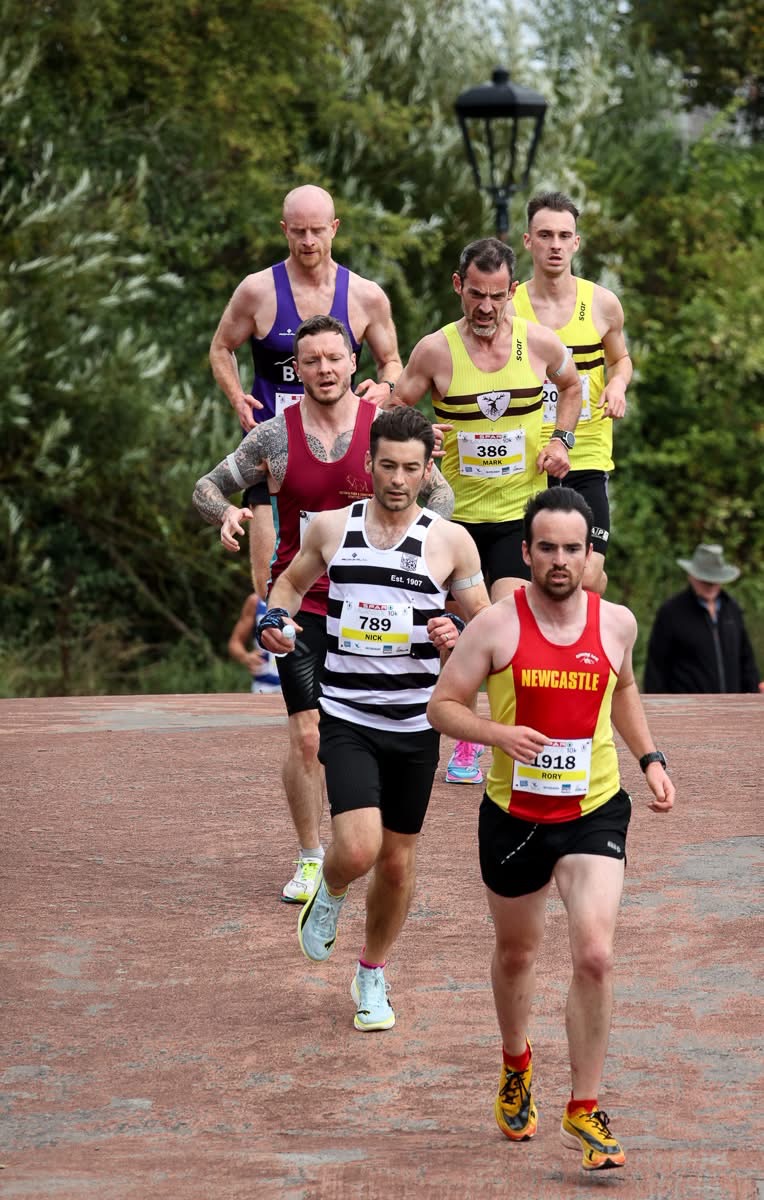
Half of the course was into a block headwind. Check the weather and work out which parts of the course will be exposed to headwinds. These are the sections where it pays to stick with others. I could feel myself getting isolated as the field strung out, but was desperate to avoid taking the 1.5km of headwind solo. I could either slow down to let others on to my heels, or put a short kick in to catch those in front. Unsustainable pace for the longer term, but worth the risk if you can get into someone’s draft where the effort level will drop.
I chose the latter. With 4km to go I ended up working with North Belfast Harrier man Oscar Purvis. We rotated well and closed down a couple more athletes who had again isolated themselves and were taking all the headwind with no help.
Know the course
Knowing where you’re going helps massively! There’s nothing slower than going the wrong way. You’d think this was obvious, but time and time again we see athletes in marathons and triathlons go the wrong side of a cone or miss a turn as they’re exhausted and not 100% familiar with the route. We were closing in on a Victoria and Connswater athlete down the embankment, but with about 1.5k to go the route turns right into Ormeau. He carried straight on, confused by the slower athletes still on their first lap. We shouted, but he had to stop and lost vital seconds, he tucked in behind but never regained his place.
Laganside has a short rise with about 6-800m to go. If you have recce’d the finish, you’ll know this. And you’ll know exactly when to unleash your finishing kick. If you’re guessing, then it’s easy to get passed by someone who knows where the finish line is and when to go ‘all in’. As it was, Oscar and I had gapped the athletes behind. He kicked on up the hill, and I just didn’t have it in me mentally (and probably physically - I found out after that I am more than twice his age!!!) to race him. I still finished fast as I dared to glance at my watch for the first time with about 350m to go, seeing that I had about 90 seconds to get in under 35 mins. I snuck in at 34:53, about 50 seconds slower than last year, but a time I could only have dreamt of a few weeks ago thanks to my achilles. 2nd M40 age cat and 10th overall out of 1400+ finishers.
Say thank you and treat yourself.
Through the finish line, it’s easy to get caught up in the post-race buzz, or a depression if the time isn’t what you wanted. However, you need to remember to smile and say thank you to the volunteers handing out medals and post-race snacks. Without them, these things wouldn’t happen. Thank your family and friends for finding time in their day to watch you put yourself through the mill yet again! I had my wife and son watching me that day. I didn’t think they’d make the start; family schedules are a constant challenge and my daughter was AWOL as usual (dancing), so it was surprising but amazing to hear a familiar ‘go, Daddy’ a few seconds after the gun. Knowing they’d be there watching at the end dragged a little bit more out of me than I might otherwise have given. Medal collected and water downed. A catch up with friends and coaching client Ash (who had smashed his PB!) Then it was off to Nugelato for a guilt-free ice cream treat for the three of us. I can highly recommend a Snickers Nugget Pot…
Final thoughts
I am clearly way off the form I had when I ran 33:17 at the Seaton Classic last year. But I am gaining fitness, and the achilles tendon, whilst sore, especially afterwards and the next day, will tolerate paces a lot faster than I’m going to be running at Berlin. I also loved competing again. That was my first competitive race since the 100k Anglo-Celtic Plate in March, and nothing beats having others around you to race against to get the most out of yourself. The 10k is a true test of where your threshold is, and I feel I have just about snuck into having the physiology of a sub-2:40 marathoner once again, though it’s going to be close! But with 2.5 weeks to go, there’s only one way to find out… Keep Showing Up!
← All articles