
17 June 2026
Running Shoes!! How do you choose the right one?
Choosing running shoes is a minefield — what suits you one day may be disastrous the next. A coach's honest guide to picking shoes that actually work for you.
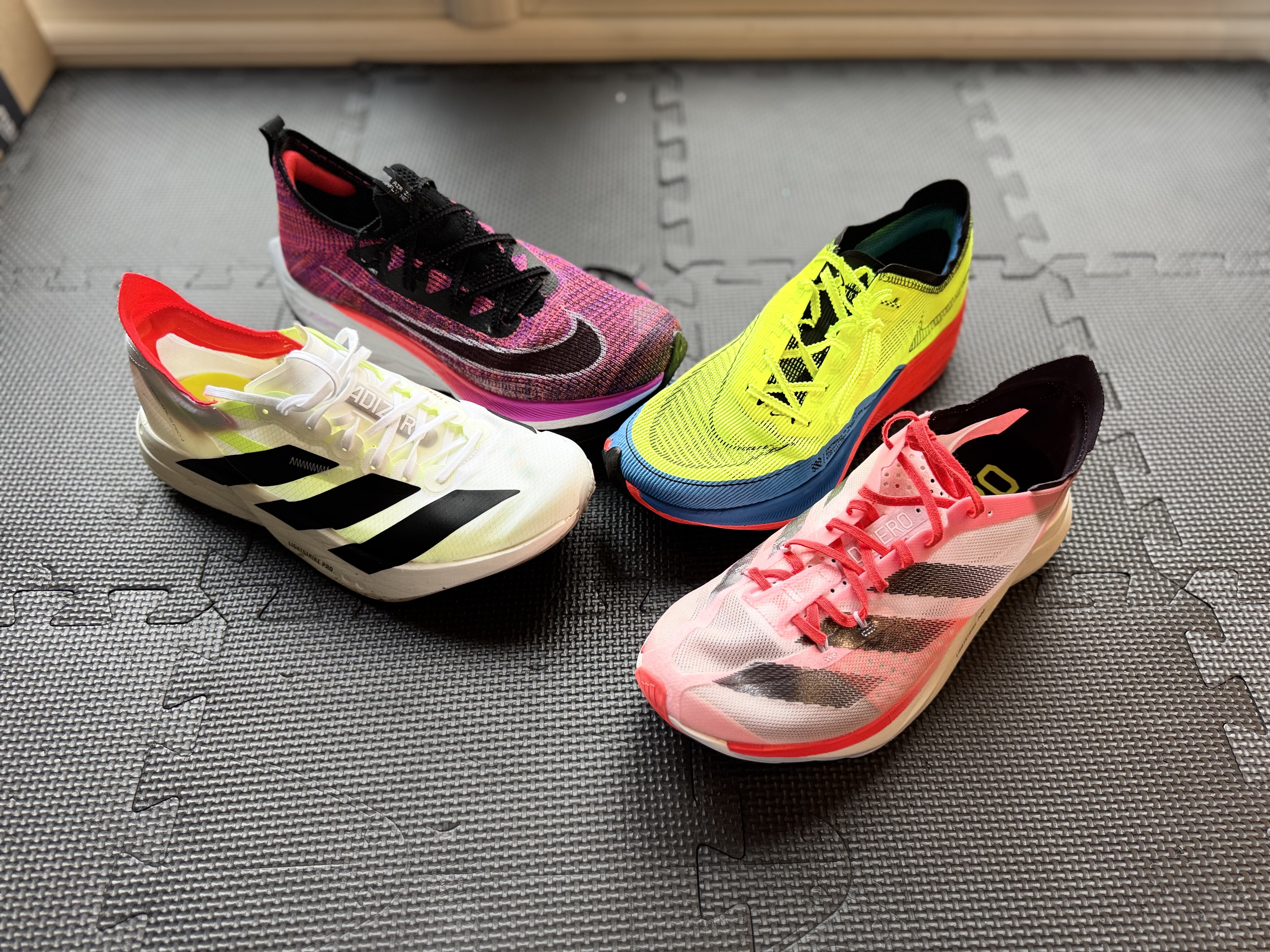

Runners love to talk about shoes. It's a topic that evolves year on year as the shoe companies come up with ever more inventive ways to convince us to part with our hard-earned cash, so we're never short of something to yarn about.
I have around 20 pairs of shoes in my rotation, ranging from Altra Torins with zero drop, to minimal Adidas Adios and from high stack Inov8 Roadfly Max, to super aggressive Puma R3s. When things are going well and I'm not carrying any injuries, I can run in anything. I have a propensity to a slightly fore-midfoot landing and an average, natural amount of pronation. I also spend my non-running life in minimalist or no footwear.
But what about when things aren't going well? Suddenly those aggressive carbon-plated race shoes that a few weeks ago had you flying along to a PB become inflammatory to an Achilles issue. The highly cushioned, high-stack 'recovery' shoes create instability in your landing and you roll your injured collateral ligaments. The super-rockered training shoe that had you pinging off your forefoot in speed sessions starts to load an injured toe joint. The flexible and more 'natural' shoe allows you to hyperflex your metatarsophalangeal joints, putting pressure on a bone stress reaction in your foot. And these are just the issues I've had in the last couple of years. The true list is probably endless.
In short, it's a minefield. What suits you one day may be disastrous the next. A shoe your friend swears by could be the worst decision you've ever made. A highly rated new style that feels great for one or two kilometres on the treadmill could start to destroy your feet once you're out on the road. The snappy 5k lightweight racer turns into a toe-masher past the half marathon distance. So how on earth do you make a decision on what to buy?
As a running coach this is a very common question, and one of the most difficult to answer. The nuance lies not only in the individual athlete, but the particular session or training block, injury history and running biomechanics.
Here are a few hints and tips that might help you on your next shoe choice:
What's everyone else wearing? Take a look around you. Are you seeing a lot of people wearing the same shoe over and over again? Don't listen to the weekend warrior who has just bought the latest social-media-boosted model and has worn them once. They may be singing their praises now, but are they still showing up in them three months down the line? Look at the experienced runner who is logging regular miles in the same pair of shoes, week in week out. The runner who loves a pair of shoes so much that they wear them to destruction is probably going to give you an honest appraisal of that model.
Are lots of different people wearing the same model as each other? If runners of all shapes and sizes are putting regular mileage in a particular version, then it's likely it's a forgiving shoe that will suit you regardless of other factors. I saw this in 2025 with the Adidas Evo SL — lots of people bought them, liked them and are still wearing them.
Have people you know bought more than one pair of the same shoe? Or replaced a worn-out pair with the exact same model? This is another sure-fire way to know that someone genuinely rates a shoe. Examples for me personally are the Nike Vaporfly 2, Adidas Adios Pro 3, Adidas Adios 8, Salomon Speedcross and Puma Fast R3. I've owned numerous pairs of these and when they were done, they were replaced with the same shoe.
Read online reviews. Not the kind that come out at the shoe launch — every shoe ever released seems to come out with a huge fanfare — but ones by real runners who aren't sponsored by any company in particular and have done plenty of mileage in a shoe.
See which shoes are winning races. The classic example was the release of the OG Nike Vaporfly. It's no coincidence that every pro field up and down the land was dominated by either the pink or the green VF1. Nowadays runners are paid big money to wear and promote certain brands, so a more realistic signpost is what the fastest local club runners at the sharp end of the field are wearing. They've had to part with their own hard-earned cash and have chosen something that will give them a return on their investment.
Try the shoes out. Properly. I'm sorry to say that I believe testing a shoe in a shoe shop on a treadmill correlates very poorly to how well you'll get on with it out in real life, day after day, mile after mile. Would you choose your next car by driving a couple of models on a rolling road in front of the showroom with the car salesman telling you how model X suits you, but model Y is maybe for someone with a shorter commute? Some companies will offer a money-back guarantee if you don't like them — I once sent a pair of Nikes back after about 60 miles, refunded, no questions asked. Check the returns policy carefully though: secondary sellers generally ask for returns to be in pristine condition, whereas the brand's own site is often more lenient.
Don't spend too much money. A general rule of thumb is that the more expensive a shoe is, the fewer people it will suit. Cheaper models are more accessible and are designed to suit a wider range of people. Take the new Puma Deviate Pure as an example — half the price of the super shoe R3, fast enough for almost every situation and a lot more forgiving on the body for the non-elite runner.
A couple of less reliable options: borrow a pair from a friend with the same shoe size. Not ideal — unless they're practically brand new, your friend will have already started to compress the foam in a certain way and set the lace tightness at a certain level. But it's a free way of checking sizing and gives a reasonable idea of what a brand-new pair might feel like. Buying from a resale site like Vinted is even riskier; the model might be a fake or well worn. But if you're lucky it can be a cheap way to test something thoroughly before committing to a brand-new pair.
If you know a running coach, ask. We have a range of athletes reporting back on all sorts of shoes. It's likely we've coached, or are coaching, someone with similar needs to you and can give you impartial advice with some experience-driven data behind the suggestion.
All in all, for anyone looking to take their running seriously, you'll likely need more than one tool for the job. But nothing really beats having solid biomechanics. If you're having issues with your feet or legs, the first thing to do is get an assessment of your body's strengths and weaknesses with a physio and/or movement coach. Don't look to correct an issue purely by buying a new pair of shoes. They might provide temporary relief, but you're opening yourself up to problems down the line if you're not working on your running form and strength.
Get the shoe choice wrong and it could put you off running for life. Get it right and you'll be a long way to being able to keep showing up year after year.
← All articles